More to follow — just getting the links up quickly to the Economist’s View blog posting. This discusses a recent (Oct 2012) Atlantic article “The Next Panic” by Peter Boone and Simon Johnson and a response by Noah Smith, “Time to Japanic?” on Noahpinion blog. This is not the first time the Atlantic’s carried an incendiary article on Japan; see James Fallows’ May 1989 piece, “Containing Japan” (the link lacks the cover art, I should have a copy of the original somewhere, and anecdotes about Fallows that I can share in class).
===== reactions: note that I glanced through the online comments to both the “Panic” and “Japanic” posts; there was only one truly substantive comment out of 100+ (now two, since I added one).
- Please cringe whenever you see the word “crisis”. We can find examples in economics – the collapse of Lehman Brothers, or the end of the peg of the Thai Baht to the US$ on July 2, 1997. When things go wrong, however, sovereign debt is a chronic disease, with a gradual onset. The patient – a country, a state – doesn’t die. In any case, for me the very first sentence of the Boone and Johnson piece raised a red flag: you don’t need hyperbole if you have a real story.
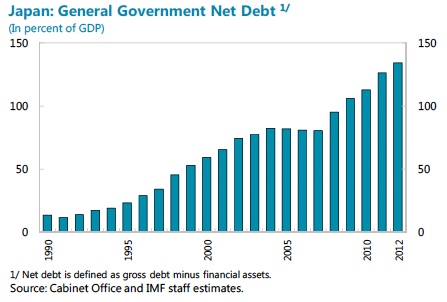
- OK, for your information here’s government debt, net of government financial assets (e.g., subtract the bonds held by the Bank of Japan).
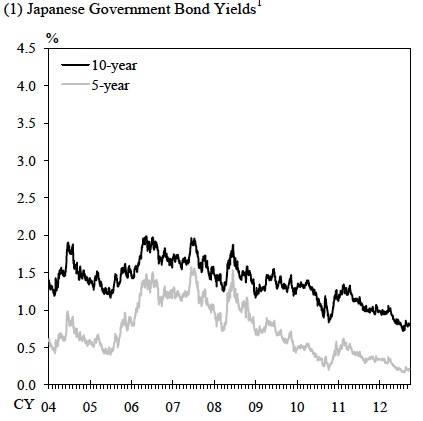
- And here’s the reaction of financial markets to this mass of bonds. Notice the panic?
- They then trot out the standard gross and net debt levels, which certainly are high, but are domestically financed. While the amount of new bond issues each year sounds huge (59% of GDP, according to them), most of that consists of debt that is rolled over: new bonds are issued to replace old bonds. The net is far smaller, a few percent of GDP, while domestic financial assets are a multiple of GDP.
- Their argument on pensions suffers from the fallacy that a country can save in advance for retirement. However, all societal-level retirement systems are fundamentally pay-as-you-go, with the modest exception of the ability to build up and then draw down foreign assets. That latter is not insignificant for Japan, but (unlike, say, Luxemburg) Japan is “large” in global markets and also comparatively “closed”. Except for the past few months (a drop in exports to China and Europe, a jump in imports of oil in the face of reactor shutdowns), Japan has run large trade surpluses. That does represent foreign savings – Japan is the second largest holder of US bonds, after China – and so they are investing a goodly portion of their savings abroad.
- Retirement must nevertheless rely primarily on domestic resources. So what matters are current tax rates, not past levels of social security taxes. And the rate that you need is a function of demographics (the ratio of retirees to workers) and the “replacement level,” the generosity of pensions relative to wages. Japan has the oldest population of any major society, as we’ve seen, but is not generous and doesn’t start paying pensions until age 64 (ane rising to age 65 in 2013). Oh, and
- Because debt relies on domestic resources, a panic can’t occur: Japanese bondholders have nowhere to flee, unlike German holders of Greek euro bonds, who could flee to German euro bonds, in a time frame short enough to represent a crisis from the Greek perspective (but not the German, since such bonds were a small share of their portfolio!). So the worst that can happen is a rise in domestic interest rates. However, I cannot tell a story where that would happen in the space of (say) a month, rather than a period of years.
- Note that I attended a 2004 State Department INR conference on “Japan’s Fiscal Volcano.” This sort of fear-mongering has been around for a long time, but the sky has yet to fall.
- Indeed, B&J don’t provide any details to match their cries of wolf. What would a panic look like? Who would sell, and why (since they’d sell at a loss, who would have to sell)?
- Much more important, they seem unaware that the government just passed a tax increase, an eventual doubling of the consumption tax (a national sales tax) from 5% to 10%. Now this won’t be enough to balance budgets – we’ll cover debt sustainability later this term – but it’s a start. And politically these are not opportune times for a tax increase.
- OK, so can I tell a story? Yes, interest rates would rise if growth returns strongly enough to start boosting domestic wages and bringing an end to deflation. That would raise interest rates. But it would also raise corporate and personal income tax returns (a lowering of that volatility to booms and busts is one function of turning to sales taxes). It would also make it easier (not easy!) to legislate another increase in taxes. In the background is an important distinction from the US case: in Japan there is a consensus across the political spectrum (and a reluctant acceptance by the general public) that taxes must increase. Now that doesn’t mean that politicians want it to happen on their watch, and so the increase has been put off time and again. However, there is no large constituency arguing that taxes are too high. (There are many constituencies arguing their taxes are too high!)
- One puzzle: Despite the record-low long-term (nominal) interest rates, Japanese debt is of surprisingly short maturity (the last time I estimated that, it was a bit over 5 years). The longer the debt that’s issued, the less the impact of any short-term increase in interest rates. I know the Ministry of Finance has talked of pushing maturities, but to my knowledge any move in that direction has been at best modest.
- Finally, and I mean it this time, the implicit scenario of B&S is of hyperinflation. Unlike in the case of the US, where a substantial portion of bonds are held by non-residents (above all, China and Japan), Japanese debt is domestic. Furthermore, the biggest obligations, those to retirees, are indexed to inflation either explicitly (pensions) or implicitly (healthcare insurance). Likewise teachers’ salaries and other expenses are more real than nominal in nature. So inflation wouldn’t restore fiscal health – inflation could lower some of the government’s real debt burden, but not all of it, but would not eliminate deficits.